
'Urbanisation results in heavy rainfall events.'

Widespread rains lashed parts of Tamil Nadu on Thursday, prompting authorities to declare a holiday for schools in Chennai and many other districts.

July and August are expected to receive 107 per cent and 104 per cent of rainfall

This interactive maps shows you the rainfall received across India in the months of June and July.
CPI inflation slowed to 9.39% in April compared with 10.39% in March.
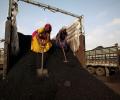
The growth in production of eight key infrastructure sectors entered a negative zone after three-and-a-half years, contracting 1.8 per cent in August 2024 due to decline in output of coal, crude oil, natural gas, refinery products, cement and electricity, according to official data released on Monday. The growth rate was 6.1 per cent in July. The growth of core sectors -- coal, crude oil, natural gas, refinery products, fertiliser, steel, cement and electricity -- was 13.4 per cent in August 2023.

The IMD has forecast heavy rainfall in some parts of the state in next 48 hours. "The southwest monsoon has arrived in Maharashtra. The onset line is passing over Harnai, Solapur, Ramagundum (Telangana) and Jagdalpur (Chhattisgarh)," IMD Mumbai centre's deputy director general K S Hosalikar said.

The planet experienced its warmest January on record last month despite the development of La Nia, a climate pattern that usually brings cooler global temperatures, the European climate agency said on Thursday. This comes on the heels of the Earth experiencing its hottest year on record in 2024, also the first to see global average temperatures rise 1.5 degrees Celsius above pre-industrial levels. According to the Copernicus Climate Change Service (C3S), January 2025 recorded an average temperature of 13.23 degrees Celsius, 0.09 degrees warmer than the previous hottest January (2024) and 0.79 degrees above the 1991-2020 average. Scientists also found that the Earth's temperature in January was 1.75 degrees Celsius higher than pre-industrial levels. Global temperatures have stayed above the 1.5-degree mark for 18 of the last 19 months.
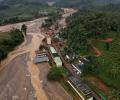
The deadly landslides in Kerala's ecologically fragile Wayanad district were triggered by a heavy burst of rainfall, made 10 per cent heavier by climate change, according to a new rapid attribution study by a global team of scientists.


As the month ended with 33 per cent deficiency, which translates to around 67 per cent of the Long Period Average, several parts of the country have been witnessing drought-like situation.

Also, the monsoon this year may end up being the driest since 2015, which recorded a rainfall deficit of 13 per cent, they said.

This should augur well for the rabi crops as delayed withdrawal will leave enough moisture in the soil for early sowing.
.jpg)
An El Nino is a temporary change in the climate of the Pacific Ocean, in the region around the equator.

Private weather agency Skymet said Mumbai is at 'serious risk of flooding' between July 3 and 5.

Domestic rating agency Icra on Wednesday said India's real GDP growth for the September quarter is likely to decline to 6.5 per cent due to heavy rains and weaker corporate performance. The agency, however, maintained its FY25 growth estimate at 7 per cent on expectations of a pick up in economic activity in the second half of the fiscal.

With rainfall and monsoons becoming highly unpredictable partly due to climate change and partly due to usual changes in weather patterns, it is such innovations by IMD which will help in planning better, reports Sanjeeb Mukherjee.

This year, the monsoon was above normal in almost all parts, except in North-West India, which comprises the major grain producing states of Uttar Pradesh, Punjab, Haryana, Rajasthan, along with states such as Himachal Pradesh, the NCR, Uttarakhand, and J&K.

The forecast for better rains this seasons comes after India witnessed one of the worst droughts in recent times when the monsoon had failed last year.

Several global models are predicting El Nio to appear around the second half of the year, which are the crucial rain-bearing months.

Heavy rains had battered the metropolis on Sunday and Monday as well.

'Temperature and wind can be predicted more easily than rainfall.' 'Rainfall, as common experience suggests, is very spotty.' 'The last bit of physics required that tells us whether it is going to rain or not is very hard.' Professor Roddam Narasimha, the eminent scientist, explains the monsoon, climate change and global warming, in a fascinating conversation with Shivanand Kanavi.

Hundreds of people are facing a shortage of food, safe drinking water and sanitation in Kathmandu following the natural disaster, according to eyewitnesses.

From a few rain gauges in 1875 to rivalling the world's best weather agencies, the India Meteorological Department (IMD) has weathered its way to becoming a global leader in forecasting.

India's crucial monsoon will be normal this year but with less heavier rains as the weather office on Friday marginally downgraded its earlier forecast.

Monsoons have had limited effect on market returns for a given year, report Sachin Mampatta and Sundar Sethuraman.

The conditions that lead to landslides, including soil texture, soil moisture and slope are known, and it is important to put all this knowledge into an operational system, he said.

The two-wheeler segment has shown signs of recovery in the first half (H1) of calendar year (CY) 2024, largely driven by improving performance in rural areas. According to the Federation of Automobile Dealers Associations, rural contribution to two-wheeler sales surged by 57-60 per cent in the April-June quarter of 2024-25, indicating a rising demand in these regions. Experts believe that this trend will continue, supported by a favourable monsoon season and government initiatives aimed at rural development.

Western Railway stated that local train services were running normally on Monday morning, however, commuters claimed trains were running late by 5 to 10 minutes.

The country received 16 per cent more rainfall than its normal limit in June, the IMD on Tuesday said.
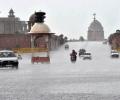
The IMD chief also allayed fears of occurrence of an El-Nino.

After becoming active over the rice-growing Indo-Gangetic plains, the southwest monsoon might witness weak phase for the next 3-4 days over the already rain-deficient region. So far, the main deficit states are Uttar Pradesh (-42 per cent), Bihar (-36 per cent), Jharkhand (-48 per cent), and West Bengal (-24 per cent). According to private weather forecasting agency Skymet, rains in west UP, Punjab, Haryana, Bihar, and Jharkhand are expected to be weak in the next 3-4 days before again picking pace.

The meeting came in the backdrop of protests by farmers bodies against the release of Cauvery river water to Tamil Nadu.

A normal monsoon will augur well for the country's agriculture sector and boost crop yields. However, good rains - and surplus crops - could also depress prices, hurting farm income, unless adequate steps are taken.

Climate scientists warn that climate change is intensifying heatwaves in India, with the cooling effects of La Nia potentially becoming less effective in a warmer future. The India Meteorological Department (IMD) predicts an early summer with above-normal temperatures and intense heatwave spells, following an unusually dry winter and the warmest February since 1901. Experts emphasize the role of human-caused climate change, along with natural climate drivers like El Nio and La Nia, in shaping weather patterns. While La Nia typically brings cooler temperatures, scientists suggest that under climate change, its ability to mitigate heatwaves may be diminished.
With different agencies showing divergent predictions regarding the southwest monsoon, the central government and states are gearing up to face adversity with various line ministries reportedly being directed to undertake mock drills and hold preparatory meetings. Around 56 per cent of the net cultivable area of the country is rain-fed, accounting for 44 per cent of foodgrain production. The June-September rains contribute around 73 per cent of the annual precipitation.

It has also predicted a below normal monsoon for the season with a Long Period Average of 93 per cent, subject to the error margin of 5 per cent.

Riding high on the hopes of a normal monsoon, the agriculture ministry aims to increase foodgrain production by 6.35 million tonnes to a record 298.3 million tonnes in the 2020-21 crop year. The foodgrain output in the 2019-20 crop year (July-June) is estimated at an all-time high 291.95 million tonnes, as per the second advance estimates released by the ministry in February.

'Usually the average rainfall per day is around 8 mm and India is receiving 10 to 11 mm per day since the last one week.' 'July seems to be very good for the entire country.'
